
 Payment Gateway
 Payment Links
 Payment Pages
 Payment Buttons
 Invoice
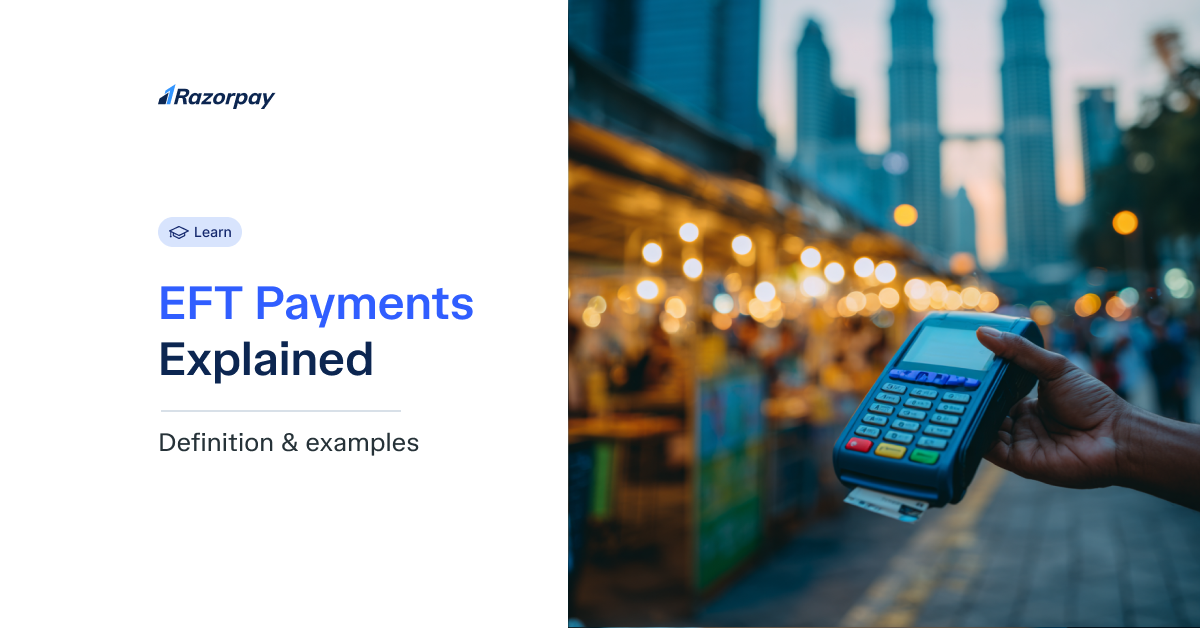
In the modern Malaysian economy, the physical exchange of cash is rapidly becoming a rarity. Whether you are paying a supplier in Shah Alam, receiving a salary in Penang, or buying groceries via a QR code, you are likely participating in an EFT (Electronic Funds Transfer).
EFT is an umbrella term that encompasses any transfer of funds initiated through an electronic terminal. In 2026, with the full implementation of mandatory e-invoicing by the Inland Revenue Board (LHDN), EFT has become the primary mechanism for ensuring that the digital trail of a transaction is unbroken and “audit-ready.”
This guide provides a clear definition of EFT, a breakdown of the specific types used in Malaysia, and practical examples of how they support business growth.
Key Takeaways
- Broad Definition: EFT refers to any digital movement of money from one bank account to another without physical paper.
- Core Malaysian Rails: The most common forms of EFT in Malaysia are FPX, DuitNow, and Interbank GIRO (IBG).
- LHDN Integration: In 2026, EFT payments are preferred by LHDN as they provide a direct digital link to validated e-invoices.
- Speed vs. Cost: Different EFT methods offer a trade-off between instant settlement (DuitNow) and cost-effective bulk processing (GIRO).
- Security: All EFT transactions in Malaysia are regulated by Bank Negara Malaysia (BNM) and protected by multi-factor authentication.
What Exactly is an EFT Payment?
At its core, an Electronic Funds Transfer (EFT) is the electronic exchange of money from one account to another, either within a single financial institution or across multiple institutions.
Unlike traditional methods that required physical cheques or cash deposits, EFT relies on secure data communication between servers. For a payment to be considered an EFT, it must be:
- Electronic: Initiated via computer, mobile phone, or ATM.
- Paperless: No physical currency or paper cheques change hands during the clearing process.
- Direct: Funds move from the payer’s ledger to the payee’s ledger.
Common Types of EFT in Malaysia with Examples
The Malaysian financial system offers several distinct EFT “rails,” each suited for different business needs.
1. FPX (Financial Process Exchange)
FPX is the standard for e-commerce. It allows customers to complete transactions using their online banking credentials.
- Example: A customer buys a laptop on a Shopify store. At checkout, they select “Online Banking,” log into their Maybank2u or CIMB Clicks account, and authorize the payment. The funds are transferred via the FPX rail.
2. DuitNow (Instant Transfer & QR)
DuitNow is Malaysia’s real-time payment system. It allows for instant transfers using proxies (mobile numbers/IC numbers) or QR codes.
- Example: A diner at a restaurant scans a DuitNow QR code at the counter. The payment is processed instantly, and the merchant receives a notification within seconds.
3. Interbank GIRO (IBG)
IBG is a batch-processing system. It is not real-time; instead, payments are processed in specific “windows” throughout the day.
- Example: A company uses its corporate banking portal to pay monthly salaries to 50 employees. The funds are sent as a bulk IBG file and typically arrive in the employees’ accounts within one business day.
4. Rentas (High-Value Transfers)
Rentas is used for high-value interbank transfers, typically for amounts exceeding RM 10,000.
- Example: A business makes the RM 500,000 payment to a developer for a commercial property purchase. This is processed via Rentas to ensure the highest level of security and immediate finality.
EFT and the 2026 E-Invoicing Mandate
In 2026, the relationship between EFT and tax compliance is inseparable. Under the LHDN e-invoicing framework, every business transaction must be validated via the MyInvois portal.
- Automatic Matching: Modern payment gateways now link the UUID of a validated e-invoice directly to the EFT transaction data.
- Non-Deductibility Risk: Payments made via cash or untraceable methods are increasingly scrutinized. EFT provides the digital proof needed to ensure that business expenses remain 100% tax-deductible.
Benefits of EFT for Malaysian Businesses
| Feature | Impact on Operations |
| Operational Efficiency | Eliminates the need to visit bank branches or handle physical cheques. |
| Improved Cash Flow | Real-time methods like DuitNow provide immediate access to working capital. |
| Enhanced Security | Reduces the risk of theft or internal fraud associated with physical cash handling. |
| Automated Reconciliation | Digital records allow for instant matching with accounting software like Xero or Sage. |
Did You Know?
As of 2026, physical cheques in Malaysia have become significantly more expensive and less common. Bank Negara Malaysia has encouraged the shift to EFT by imposing a “cheque processing fee” while keeping most DuitNow and FPX transactions free or low-cost for consumers and micro-SMEs.
Ready to Modernise Your Business Payments?
Stay ahead of the curve with a payment gateway that integrates seamlessly with your digital tax workflow. From FPX to automated reconciliation, ensure your business is compliant and audit-ready for 2026.
Explore Payment Solutions from Razorpay Curlec.
Conclusion: The Foundation of Digital Trade
EFT is no longer just a technical banking term; it is the foundation of digital trade in Malaysia. By understanding the different types of EFT—from the instant gratification of DuitNow to the bulk efficiency of GIRO—business owners can optimize their cash flow and ensure they meet the rigorous transparency standards of 2026. Transitioning your payment collections to a unified EFT-capable platform is the single most effective way to future-proof your business in the Malaysian digital economy.
Frequently Asked Questions (FAQs)
1. Is a credit card payment considered an EFT?
Yes. While often categorized separately in retail, credit card transactions are technically a form of EFT because they move funds electronically from the card issuer to the merchant’s bank.
2. How long does a DuitNow transfer take?
DuitNow transfers are instant. The recipient should see the funds in their account within seconds, 24/7, including weekends and public holidays.
3. What is the difference between IBG and Instant Transfer?
Instant Transfer (often via DuitNow) happens in seconds. IBG is a batch system; if you send money in the morning, it may arrive in the afternoon. If you send it after 5 PM, it will likely arrive the next business day.
4. Do I need a special account to receive EFT payments?
Most standard business bank accounts in Malaysia are already enabled to receive EFTs. However, to collect payments professionally via your website or app, you should integrate with a payment gateway.



