
 Payment Gateway
 Payment Links
 Payment Pages
 Payment Buttons
 Invoice
Key Takeaway:
- A payment terminal malaysia merchants use is hardware that reads card data and communicates with banks to process transactions.
- Modern terminals support multiple payment methods: chip cards, contactless tap, e-wallets like Touch ‘n Go, and QR codes.
- Every card payment terminal connects to a payment processor or gateway that handles the actual fund transfer between customer and merchant accounts.
- Malaysian businesses can choose from traditional countertop terminals, portable wireless devices, or mobile card readers depending on their setup.
- The terminal is just the front end—pairing it with a reliable credit card payment gateway ensures transactions are processed securely and settled promptly.
Table of Contents
- What Is a Payment Terminal and How Does It Work in Malaysia?
- What Exactly Is a Payment Terminal?
- How Payment Terminals Process Transactions
- Types of Payment Terminals in Malaysia
- What Malaysian Merchants Need to Accept Card Payments
- Choosing the Right Setup for Your Business
- FAQs
You’ve seen them at every checkout counter. That small machine where customers tap their cards, insert chips, or wave their phones. That’s a payment terminal—sometimes called a POS terminal, card machine, or EDC machine.
But what’s actually happening inside that box?
A payment terminal Malaysia merchants use is essentially a secure communication device. It itself doesn’t hold your money or make decisions about whether to approve payments, but connects your business to the banking networks that actually move funds. Because of its role in handling transactions, it’s important to understand how it fulfills its purpose. Let’s get into it.
How Payment Terminals Process Transactions
The whole process takes seconds, but a lot is happening behind that blinking screen. Here’s the simplified version.
Step 1 — Card Data Capture
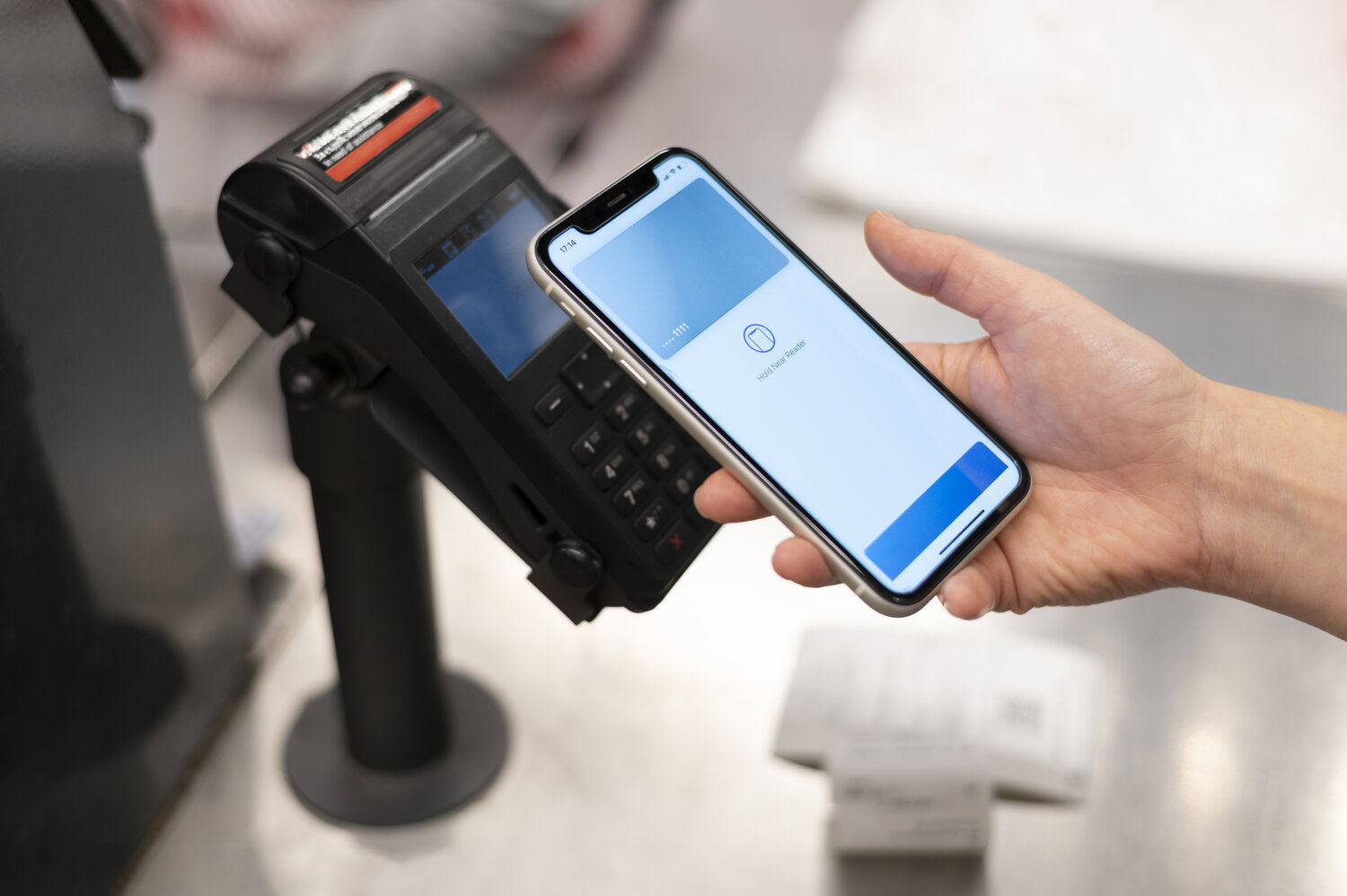
When a customer taps, inserts, or swipes, the card payment terminal reads their payment credentials. For chip cards, this involves encrypted communication with the card’s chip, whereas contactless payments use NFC (Near Field Communication) to transmit data wirelessly.
The terminal can also read older magnetic stripe cards, which store data on that black strip at the back.
Step 2 — Encryption and Transmission
The terminal encrypts the card data immediately. This isn’t optional, being mandated by PCI-DSS security standards. The encrypted request then travels through your payment processor to the card network (Visa, Mastercard, etc.) and onto the customer’s issuing bank.
Step 3 — Authorisation
The issuing bank checks whether the customer has sufficient funds or credit, whether the card is valid, and if anything looks suspicious. This decision takes roughly 1 to 2 seconds.
Step 4 — Response
The response, regardless of whether approved or declined, travels back through the same network to your terminal. If approved, the terminal prints or displays a receipt, and the transaction is logged for settlement.
Step 5 — Settlement
At the end of each business day (or according to your settlement schedule), all approved transactions are batched and submitted for actual fund transfer. This is when money moves from customer accounts to your merchant account—typically within one to three business days.
Types of Payment Terminals in Malaysia
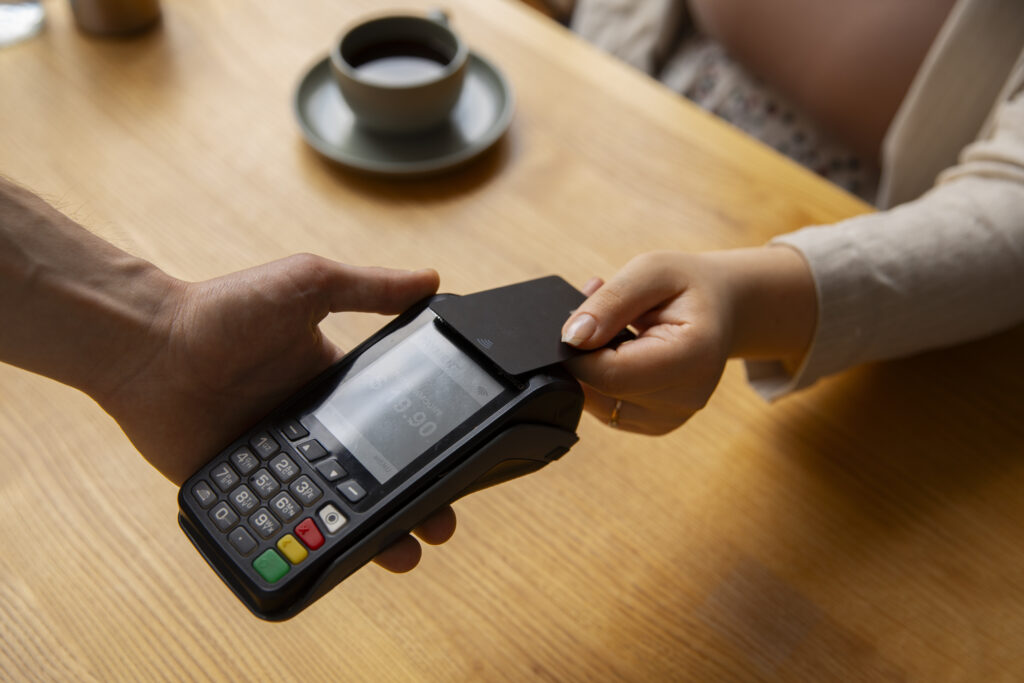
Not all card payment machine Malaysia merchants use look the same. The right choice depends on how and where you sell.
Traditional Countertop Terminals
The classic setup. These sit at your checkout counter, connected via Ethernet or phone line. Reliable, sturdy, and familiar to customers. Best for fixed retail locations like shops, restaurants, and clinics where transactions happen at one spot.
What’s more, countertop terminals often have built-in receipt printers and support chip, contactless, and sometimes QR payments. Many Malaysian stores use this.
Portable Wireless Terminals
Same capabilities as countertop models, but with wireless connectivity (WiFi or mobile data). Staff can bring the terminal to the customer, which is useful for table service at restaurants or queue-busting during busy periods.
A wireless payment terminal Malaysia businesses use commonly runs on rechargeable batteries, making them flexible but requiring occasional charging.
Mobile Card Readers (mPOS)
Popular with small businesses, market vendors, and service providers who operate on the move, mobile card readers are compact devices that connect to smartphones or tablets via Bluetooth. With one, a food truck or a freelance photographer can accept card payments without investing in bulky equipment.
mPOS readers are affordable and portable, though they depend on your phone’s battery and data connection.
Smart Terminals
The newer generation. Smart terminals run on Android operating systems, feature touchscreens, and can do more than just process payments, such as managing inventory, running loyalty programmes, and customising receipts.
As they bundle multiple functions into one, merchants increasingly prefer this new card payment machine in Malaysia for their versatility.
What Malaysian Merchants Need to Accept Card Payments
The terminal is just one piece. Here’s what you actually need to start accepting card payments in Malaysia.
A Merchant Account
This is a special bank account that receives funds from card transactions. Some providers bundle this with your terminal rental, but others require you to set it up separately with an acquiring bank.
A Payment Processor or Gateway
Your terminal needs to connect somewhere. A credit card payment gateway handles the communication between your terminal, the card networks, and the banks involved. This is the engine that powers every transaction.
If you’re a business that also sells online, you’ll want a gateway that supports both physical terminals and e-commerce payments to ease your operations.
The Terminal Hardware
You can purchase terminals outright or rent them monthly from your payment provider. Rental often includes maintenance and replacement, which is useful if hardware issues arise.
Business Registration
Payment providers require valid SSM registration. Sole proprietors, partnerships, and Sdn Bhd companies can all apply, but the documentation requirements can be slightly different.
Choosing the Right Setup for Your Business
A mamak stall has different needs than a boutique in Pavilion. Consider these factors when selecting your card payment terminal setup.
- Transaction volume. High-volume businesses benefit from robust countertop terminals. If you’re dealing with lower volumes, mPOS readers may be a better fit, offering minimal monthly fees.
- Mobility needs. If you’re stationary, a countertop works fine. But if you need to move around for events, deliveries, or tableside service, going for portable or mobile options make sense.
- Payment methods. Malaysians use cards, e-wallets, and QR payments. Make sure your terminal supports DuitNow QR and popular e-wallets, not just Visa and Mastercard.
- Integration requirements. Check if your terminal needs to sync with your POS system, accounting software, or inventory management. If so, a smart terminal may be a better fit than a basic model.
The Terminal Is Just the Start
Understanding what a payment terminal Malaysia setup involves is the first step toward going cashless. The hardware captures payments, but the real work happens through the payment infrastructure behind it.
That’s where your choice of payment gateway matters. A reliable credit card payment gateway ensures transactions process smoothly, settlements arrive on schedule, and your business stays protected with proper security compliance. Razorpay Curlec’s payment gateway supports Malaysian merchants with seamless processing for both online and offline transactions, giving you one unified system regardless of how customers pay.
Ready to accept card payments? Explore Razorpay Curlec’s credit card payment gateway and find the right setup for your business today!
References:
1. Pages – Registration. (data n/a). Suruhanjaya Syarikat Malaysia (SSM). Retrieved on 26th January 2026 from https://www.ssm.com.my/Pages/Services/Registration-of-Business-(ROB)/Registration/Registration.aspx
FAQ
Q1: How much does a payment terminalcost in Malaysia?
A: Costs vary by provider and terminal type. Basic card readers start around RM200-400 to purchase. Traditional terminals can be rented for RM50-150 monthly, often including maintenance. Smart terminals cost more—RM300-500 monthly rental or RM1,500+ to buy outright.
Q2: Can payment terminals accept e-wallet payments?
A: Yes. Most modern terminals in Malaysia support e-wallets like Touch ‘n Go, GrabPay, and Boost via QR code scanning or NFC. Confirm which e-wallets your provider supports before signing up.
Q3: Do I need internet for a payment terminal to work?
A: Most terminals require connectivity—either WiFi, mobile data (4G), or ethernet. Some terminals offer offline mode for temporary outages, storing transactions until connectivity resumes, but this isn’t available on all devices.
Q4: What’s the difference between a payment terminal and a payment gateway?
A: The terminal is physical hardware that captures payment information at the point of sale. The gateway is the software/service that processes that information, communicating with banks and card networks to authorise and settle transactions. You need both to accept card payments.
Q5: How long does it take to set up a payment terminal?
A: With self-onboarding providers, setup can take 3-7 business days, including application approval and hardware delivery. Traditional bank-based merchant accounts may take 2-4 weeks.



